
Official Statement on
The Passion Translation
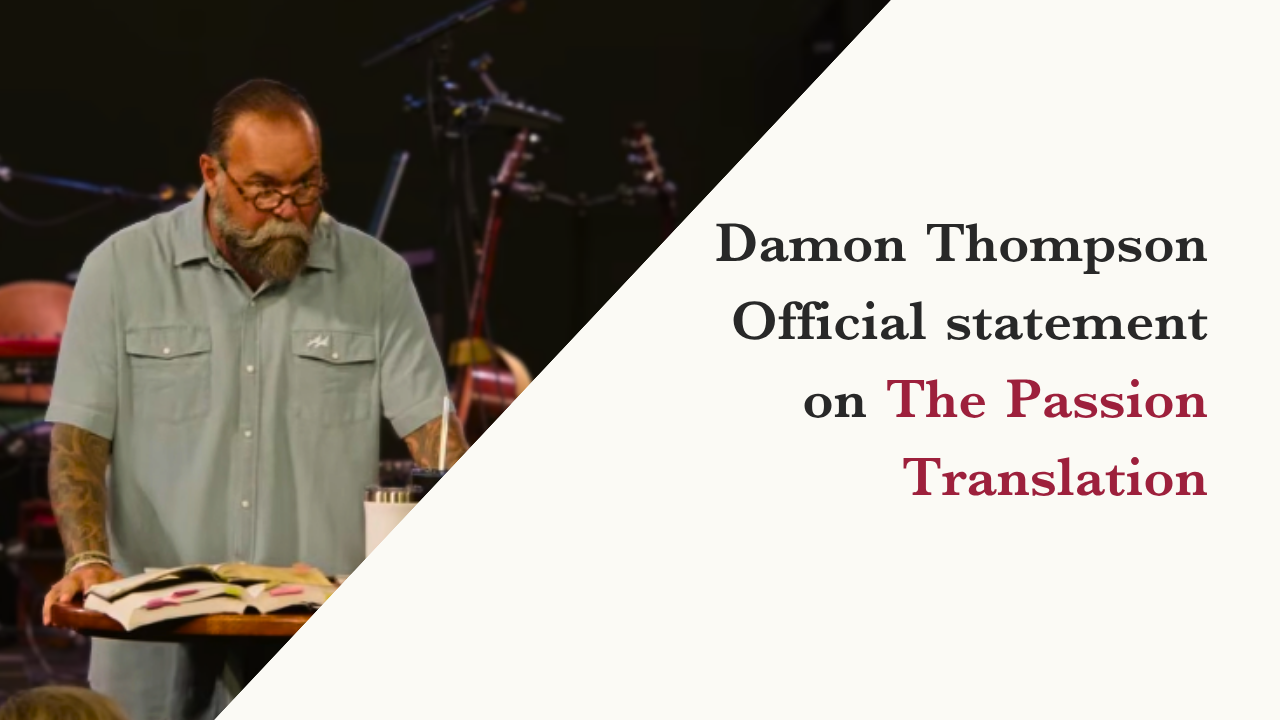
For many years, I have taught from The Passion Translation as a primary text in my ministry. I have done so because I believed it captured dimensions of the original languages that other translations had not rendered with sufficient depth. I am always endeavoring to gain as much understanding as I can regarding Scripture, and I believe this longing for a more complete and robust understanding of Scripture is right and good.
However, on June 25th, 2026, it was brought to my attention that the scholarly foundation upon which The Passion Translation was built is not what it was represented to be. Credentials have been misrepresented, and source material has been used without attribution.
I would add that my use of The Passion Translation was never uncritical. On numerous occasions over the years, in public ministry settings, I voiced my disagreement with specific renderings where I believed the translation had missed the weight of the original text. I did not approach this translation as being beyond question. I approached it as a tool—one I believed captured something valuable—while maintaining the responsibility to evaluate it against the broader witness of Scripture. That posture of critical engagement is precisely what has led me to this moment of public correction.
My Greek work was not something that I depended on The Passion Translation for, but rather something I pursued using other study tools. However, Aramaic—a language that I believe Jesus Himself spoke—is a language that I know very little about, and I trusted that The Passion Translation was a reliable source of information regarding the Aramaic. I no longer have that confidence.
Obviously, those of you who know me well will understand that at no point in my use of this material was there any intention to deceive. I have always taught what I believed to be true, based on sources I believed to be reliable. Any suggestion that I knowingly misled the people entrusted to my care would not be accurate in any way. My entire ministry has been built on a pursuit of both Spirit and Truth, and that pursuit is precisely what compels me to make this correction now.
If this is difficult for you to hear, and even painful to hear, I want to say that is completely understandable. It has been difficult for me as well.
To this I would say that God puts His treasure in earthen vessels, and our hope is never to be in a man. Our hope is found in the one perfect Man, whose name is Jesus.
We will be making an adjustment in which translation of Scripture we will be using, and we will continue to trumpet this high Christology that is so central to our culture.
To the younger generation, I would say that if you want to change to a Bible translation that is equally easy to read and is a solid translation, I would recommend The New Living Translation.
It would be dishonest for me not to admit that I vigorously supported and used The Passion Translation over the years. I have even given copies to those I love. I encouraged my own sons and wife to read it.
I taught what I was given. I believed the sources I trusted were as advertised. But belief in a source does not make that source completely reliable, and sincerity does not make a translation defensible. I have held myself to a standard of integrity in this ministry for many years, and that standard requires me to say plainly: as a result of these issues of misrepresented credentials, as well as plagiarism, I am withdrawing my endorsement of The Passion Translation.
I want to be clear about what I am not saying. I am not saying that the work of the Holy Spirit in the lives of those who encountered God through that translation was not real. I am not saying that the hunger for a deeper encounter with Scripture that drew people to that translation was wrong. I am not saying that the men and women who taught from it were insincere. I am saying that the foundation was not what we were told it was, and integrity demands acknowledgment of that reality, as well as a personal apology from me.
Let me be clear here: the issue I am addressing is primarily in regard to plagiarism, as well as the misrepresentation of personal academic credentials.
My error in this was that I trusted what was written to be accurate. To cite one specific example, there is a footnote I shared in John 14 regarding the Holy Spirit as the Paraclete, and that footnote was altogether inaccurate. I am sorry for teaching something to you that was incorrect in that regard. It was not my intent, but it was my responsibility, and for this I want to sincerely apologize.
I am committed to continuing to preach the fullness of the FINISHED WORK OF CHRIST—His comprehensive victory at Calvary, the reality of Abba's love, and the transforming work of the Holy Spirit in both the interior life of every believer and His consequent work within the cosmos. None of that changes. What changes is my responsibility to ensure that the sources I build from can bear the weight of what I feel called to teach.
I am not telling you what to do with your own copies of The Passion Translation. I am simply informing you that, from this platform, as well as in my personal study, I will be using other translations going forward.
I am grateful for every person who has extended grace in this moment, and for the leaders whom I reached out to for prayer and wisdom.
I will be using The New Living Translation, as well as other translations that I have come to trust over the years, such as The English Standard Version and The New American Standard Bible.
I ask for your continued prayers as I remain committed to a standard of integrity that the people of God deserve from those who stand before them with an open Bible.
Sincerely,
Damon Thompson